Showing posts with label news. Show all posts

Thursday, July 16, 2009

The Coming Age of Paid News

?fh=dd71e0c771519c6269c9a68b63fe1c9fI haven't bought a real, physical newspaper in years. And yet I read online versions of newspapers aggregated through Google every day. And this Doonesbury cartoon does a pretty good job of encapsulating the results of an entire society doing the same thing. And certainly there is a lot of breast beating by journalists about the way that Google and Yahoo supposedly steal food from their mouths by posting links to their content. But the plight of newspapers is bigger than Google News, Google Reader, and bloggers posting links to their content. Linking to online newspaper articles drives readers to newspaper websites and generates at least some ad revenue. There is also an elephant in the room that the newspapers don't like to talk about when they talk about search engines and blogs linking to their content. Newspapers also make a lot of money off of classified ads. Or at least they used to. With Craigslist stealing the classified ad business which newspapers used to own, things start getting grim.

And forcing Google, Yahoo, or even bloggers to pay for linking to news websites sounds like a pretty good way for newspapers to cut off their nose to spite their face. (On a personal note, I actually had to look up that saying before I wrote it down, my original mangled version of that idiom was much more disturbing.) It doesn't bring back the classified ads revenue and it sets up a dynamic not unlike the one that currently exists with the music industry which is currently alienating an entire generation of its fans by suing people willy-nilly.

So what is the answer? At the moment there is none but there is certainly a lot of experimentation going around. Plenty of journalists have been pushed out of old media like newspapers, radio, and television and found a home on the web as bloggers. And some of the bigger blogging sites like Huffington Post and The Daily Beast are growing larger and have the resources to act more like traditional newspapers. (He writes having rarely if ever visited either website.) It's possible that big professional blogs will eventually replace traditional newspapers altogether. It's also entirely possible that in the future newspapers will go completely online and will rely on either contributions or on some sort of micro-payment system which is reasonable and convenient enough that people are actually willing to pay it. This is pretty much what is happening now with iTunes and the Amazon MP3 store. While most teens still won't pay for music, older people are perfectly willing to trade a few dollars for the convenience of being able to download music from one reliable place at a low price. Or maybe the future of news looks more like TV and radio, multiple shows and channels all supported by advertising. I just hope that they don't overdo it.

Moreover devices like Amazon's Kindle promise to open up a whole new market for bloggers as they allow people to carry thousands of books and subscribe to hundreds of newspapers (which are updated every day), all in a relatively compact device. Of course these days tiny laptops are almost as compact and software similar to that of the Kindle's can be programmed for them. But laptops are real computers and their software can be hacked to remove the DRM software which controls what can and cannot be loaded onto the Kindle. The Kindle by contrast is completely "safe" from such shenanigans. This is why I think that in the end the newspapers' problems are more about control than they are about money. A big newspaper like the New York Times could potentially save a lot of money right now if they just gave all of their subscribers a Kindle but they will likely resist the move lest a user hack their device to read for free. So instead everybody reads for free.

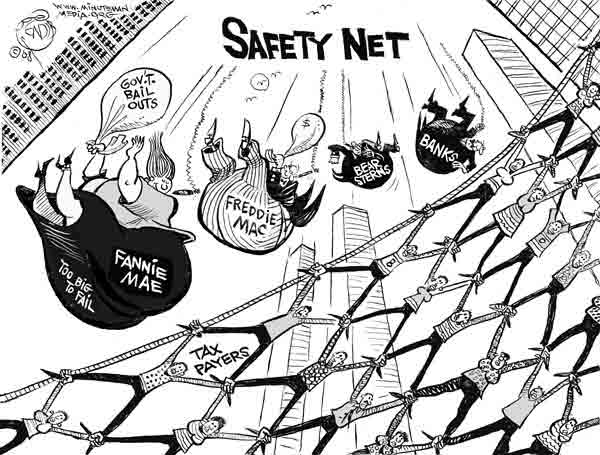
As a post-script to these meandering thoughts I'd like to point out that many of the bigger newspaper bankruptcies have happened in part because they were mismanaged into the ground. And we certainly don't reward financial mismanagement in this country. OK, so we do; but the newspapers aren't too big to fail. Maybe the newspapers (and the mainstream media in general) need to ask themselves if they deserve to survive at all. While they are good at reporting body counts for the was Iraq, they did piss poor job of considering arguments that might have kept out of that war. Similarly, they've proven very good at detailing gory details of our economic crisis but did little to warn us that it was coming. And those who tried to warn us were generally laughed at. (I realize that the last link was a to a clip from CNBC, a cable TV network but radio and newspapers were every bit the enthusiastic cheerleaders to our exuberant economy which crashed so embarrassingly with every talking head on TV telling us that we had no way of knowing what was coming.)

Monday, June 15, 2009

The Revolution Will Not Be Televised—But It Is Being Twittered

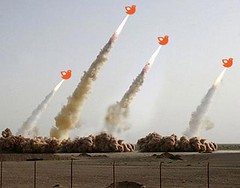
Tweet MissilesImage by Zoolcar9 via Flickr

Following the Iranian election on Twitter is turning into an addiction for me. Television reporting during the early hours of the story was pretty sporadic but people keep talking about it despite the Iranian governement's repeated attempts to tamp down on the it. I guess this is the future of news. People gossiping to each other online about what's going on in their area and hopefully we'll figure out what happened when the smoke clears.

It's interesting at this point to turn the clock back to the past and ask how we got here. This isn't the first time that political turmoil has changed the way we get our news. Back in the '90s CNN rose to prominence in part because of its coverage of the fall of the Soviet Union and 24/7 cable TV news became the dominant news medium. Before that television replaced radio and and radio replaced newspapers. Note that all along the line, each medium "replaced" the one before it in only the broadest possible sense. Newspapers while they are struggling to survive today, still continue to publish. Similarly, radio continues to be a powerful medium even if it has been replaced in terms of influence by television. And more people was the network evening news that cable TV news. So now that the Internet is replacing other media as the dominant source for news it's in parts because we have been linking to New York Times articles and MSNBC video and Twittering about stories we've seen on television.

Think of information as a sphere that surrounds you. As communication technology advances, that sphere expands and fills up with sources of information that we can use to access it. But until the Internet, there was nothing to hold it all together. The Internet acts a glue that helps its users hold on to information. It's no wonder the mainstream media is struggling to integrate itself with Internet services like Twitter, sometimes with embarassing results.

Tuesday, June 9, 2009

He Makes Them Look Bad Too

Say what you will about our president. His extravagant dates with his wife may make the average American husband look bad but think what how they make husbands in other countries look....
?fh=8d625eb497d0c36f8ef7412c38854353

Sunday, May 24, 2009

Map The Fallen

Here's a rather sobering piece of software for Memorial Day. Map the Fallen is a Google Earth plug-in which displays an interactive map of soldiers killed in Iraq and Afghanistan. Trying the timeline which begins in October 2001, you can see little yellow symbols fill the screen as more soldiers are killed over time. Linking the soldier's home town to his or her place of death, it makes allows you to "fly" from one place to the other. It also shows how international the war has become showing European soldiers who've been killed in the war. It gives a pretty sobering perspective to the politicians who chatter about the war in abstract terms on the Sunday morning chat shows.

Sunday, March 29, 2009

Red River Flooding

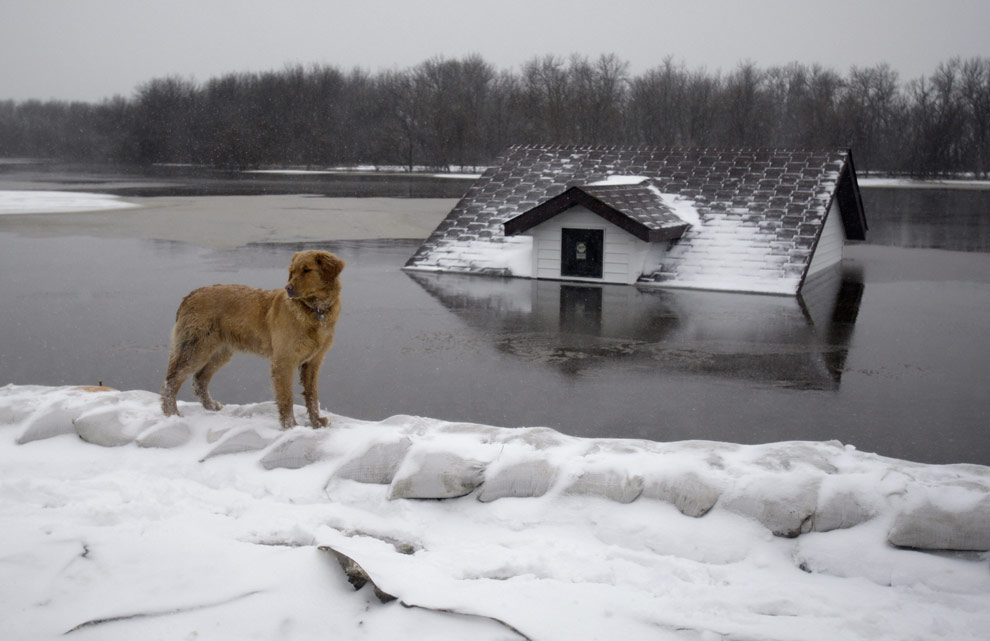
turnleftonpapug has a link to some amazing footage of the flooding on Red River along the Minnesota-North Dakota border.