
Showing posts with label windows. Show all posts
Showing posts with label windows. Show all posts
Friday, October 16, 2009
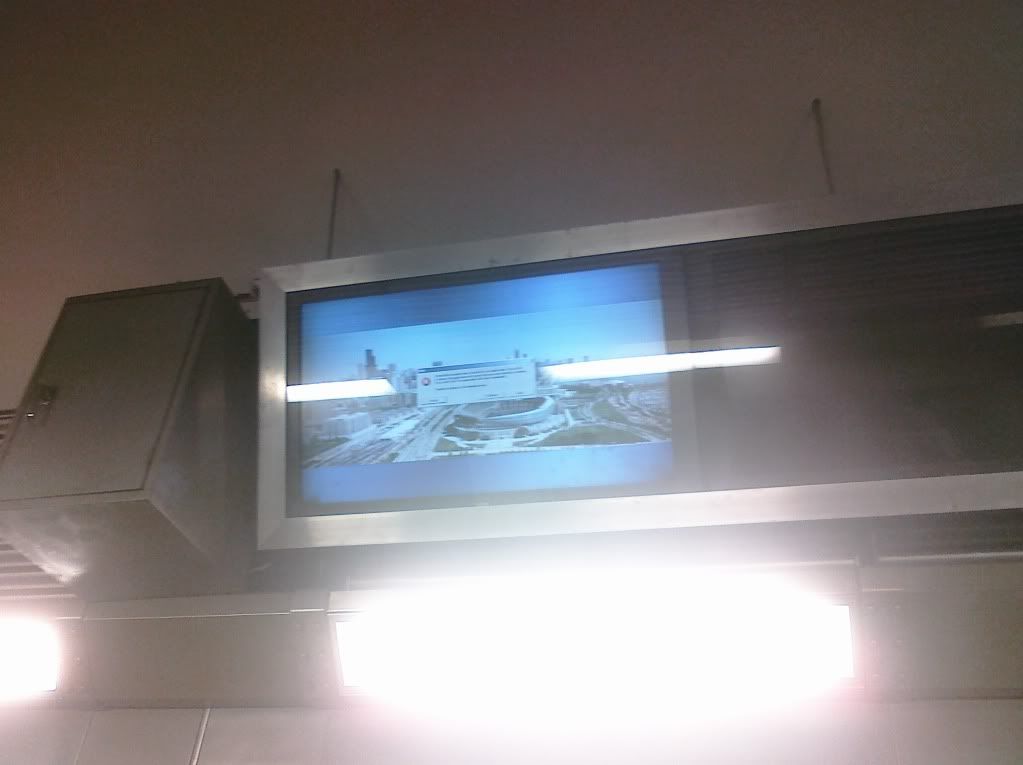
Today's Windows Error at a Public Place...
...comes to you courtesy of the Chicago Transit Authority's Blue Line train station at Clark & Lake. At least it wasn't a Blue Screen of Death and it's not like Chicago is hosting the Olympics.


Saturday, May 30, 2009
Too Many People Want a Piece of Firefox These Days
 Boing Boing Gadgets links to a Washingpost blog which complains about Microsoft quietly installing a Firefox extension without permission. This isn't the first time that this has happened. While I like AVG Antivirus, they have been installing their own Firefox extension for quite some time. As with Microsoft, they do this without permission, probably on the idea that they are doing it for the user's own good. But this is a troubling trend. One of the reasons that I use Firefox in the first place—indeed the reason most people probably use Firefox—is because of the degree of customizability and control that is allows. When companies decide that they can install extensions on their users computers willy-nilly, that is a bad thing. They are essentially telling their users, "We know better what's good for you." It erodes trust and quite frankly I'm not even sure that it is legal. Firefox afterall is made by an independent company, they are not owned by Microsoft or by AVG Technologies. So my question is, aren't these companies acting like virus writers when they do this and potentially opening themselves up to a lawsuit? If so, it would probably serve them right.
Sunday, May 17, 2009
Windows 7's Potentially Show-stopping Boot Up Problem
 Image by Mimi_K via Flickr
The story begins a few months ago when I tried to build a file server with Via's new Artigo 2000 box using 32-bit Windows XP Professional and two 2 Terabyte Western Digital hard drives. It was a pretty nice little machine but it just wasn't robust enough to handle moving thousands of little files across a network. It would crash from time to time and couldn't reliably transfer video files to my TiVos. So I decided to scrap the experiment and maybe try later with a dedicated server OS like FreeNAS. In the meantime, I still had a lot of files to move around multiple computers. So I rebuilt my Shuttle XPC with a dual core processor and 2GB of RAM. While I had used this computer as a file server before I hadn't been happy with the results and felt that it was overkill for just serving up files to other computers. Nevertheless I stuffed the two Western Digital drives in that box and installed the 64-bit version of the Windows 7 RC on it. The result was a very fast computer with 4TB of storage space that didn't crash when I used it to serve video to my TiVos.
Things went great with my new rig until Windows 7 decided that it needed to install updates and reboot. When it rebooted, the dreaded "ntldr missing" message reappeared and unlike with my laptop, it has stuck around for several reboots. Poking around the Internet, I saw that is happening to other people as well. I have tried several solutions but have yet to find one that works....Other than keeping my Windows 7 DVD in my CD drive during boot up.
Now perhaps this problem is my own fault for being careless but still it is a serious problem troubles me.
![Reblog this post [with Zemanta]](http://img.zemanta.com/reblog_e.png?x-id=fe28fe7b-0a5f-447a-8900-9eeb941b4e1d)
Thursday, May 7, 2009
Windows 7 Exploit is a Blast From the Past

Geek.com reports on a "new" exploit found by F-Secure. I put the word new in quotes because it's really a very ancient exploit. I remember when the first scripting viruses came out, they took advantage of two features in Windows. The first was the newly introduced Windows Scripting Host which allowed users to create little files full of commands which would control Windows—in much the same way that DOS batch files control DOS. They also took advantage of the fact that Windows by default hides the extensions of most of the files on your computer. Typically you would receive an email message with an attachment which was supposed to be a picture or a document and was in fact a script full of malicious commands.
This was ten years ago. And this exploit is still possible. At least back then, it was possible to tell that a script was not a real document because Windows would give it an icon which differed from the normal icon it would assign to a real document. For example, a Word document would get a Word icon while a script with fake .doc extension would get a Windows Scripting Host icon. Nowadays, it is more common to use an executable with a fake extension and a proper icon for the document that it purports to be. Of course it still has a second .exe extension which would normally be a dead giveaway save for the fact that Windows will by default hide that second extension, unwittingly helping you get hacked more easily.
Ten years. And Microsoft still won't fix this serious security problem because it supposedly makes your computer easier to use. One of the first things I do with a new computer is to open up the Computer (My Computer in XP and older versions of Windows) item and select Tools | Folder Options. Then I click on the View tab and uncheck everything that Microsoft normally hides. Pretty much everyone who knows something a little bit about computers should do this—it just makes sense.
Wednesday, May 6, 2009
Windows 7 RC Quick First Impressions
 About two hours ago I inserted my Windows 7 Release Candidate disk into my spare laptop's CD-Rom tray and for the most part I'm done. Windows 7 is still complaining that I need to install an anti-virus program and I do need to re-install the software I normally use on my computer but other that I'm up an running having installed Firefox.
The installation process was fairly straightforward. I already had the Windows 7 Beta installed on this machine. It was the 32-bit version and I used the 64-bit version of the release candidate so I couldn't just upgrade the Beta. Microsoft recommends a "clean install" anyway so I restarted the machine with the RC in the CD-Rom tray and let it install. This took about an hour. The computer restarted several times during this process.
Near the end of the install, Windows offered to activate itself automatically and asked for the key to my wifi hotspot. This was a fairly clever thing for it to do. Unfortunately, I have a 63 character wifi key which I keep on a USB flash drive and there was no way to get the wifi key off the flash drive and into the connection dialog box. No biggie, I just let Windows start and it already had a connection icon in the taskbar. I just clicked on the icon, chose my wifi hotspot from the pop up list, and copied and pasted the wifi key into that dialog box. I've noticed in the past that Windows Vista allows you to export your wifi key onto a flash drive in some (hopefully encrypted) format but never bother to use this feature. Perhaps people who have used this feature might be able to just insert flash drive into their computers and have Windows 7 recognize their wifi keys. Despite this problem, one of the big improvements going from Windows Vista to 7 is the improved ease in connecting to secured wifi hotspots.
When Windows finally came up it was with a fairly generic configuration at a relatively low resolution of 1024x768 giving my laptop's widescreen a fuzzy, squashed appearance. As I poked around the interface, Windows continued to look for updates and found seven of them, including the software drivers for my NVIDIA graphics card. I let Windows install the updates and reboot. Suddenly my laptop took on a more familiar appearance at its full 1280x800 screen resolution. Curiously, Windows went with a basic theme for my computer and I had to choose an Aero theme in order to get its pretty transparencies to appear. Windows was ready to go.
Now for first impressions. So far there are no surprises. I've been using the Beta for months and the changes which the Release Candidate brings are fairly subtle. While it gets rid of many of Vista's annoyances, there are still many which remain from Vista. Windows Explorer for example still tries to hide its menu and status bars and still comes with default settings which hide system files and generally make it a lot less useful. Luckily, as with every version of Windows, you can change these settings and make Explorer a much more useful program for organizing your computer.
Many have regarded Windows 7 as "Vista Service Pack 2.0." I prefer to think of 7 as "Vista done right." For example, unlike Windows Vista where themes and appearance mean two different things, they are pretty much the same in Windows 7. If you choose an Aero theme, Windows Aero Glass interface starts with it. If you choose a basic theme Aero shuts down. Vista by contrast has its themes and it has its color schemes. You can shut down Aero without changing themes in Vista and vice versa. By contrast if you want to shut down Aero in Vista, you have to choose a basic or high-contrast theme. While this led to some confusion for me at first, the more I think about it, the more Windows 7's way of doing things makes sense. Why bury so many options someplace which most users never see? In Windows 7 these options are displayed beneath the more popular ones and are easy to get to.
Many have always regarded Windows itself as a rip-off of the MacOS and Windows 7 definitely does take some of it cues from MacOS X. In fact it takes a few too many many cues from OSX. I've always felt that the OSX Dock while very pretty has always been very disorganized and sometimes confusing for new users—a triumph of aesthetics over usability. In Windows 7 the taskbar hews more closely to the Dock, removing the labels from running applications and mixing them together with Quick Launch shortcuts. Fortunately, you can restore the labels. One change that actually improve the user experience by adding thumbnail displays of your applications to the taskbar.
It a continuing the trend from Vista, 7 adds a lot of pretty eye candy with lots of themes and lots of background pictures and a link to more online. It also adds subtle performance improvements and a much smoother interface than Vista. I never expected to find myself excited by a new version of Windows but 7 definitely gives me something to look forward to in the Windows world.
Tuesday, May 5, 2009
Windows 7 Release Candidate is Out
There isn't much to say about this; Windows 7 RC was released a few hours early last night by Microsoft. It will remain usable for a year (the current Windows 7 Beta expires in June). So Microsoft is giving its users a rare opportunity to play with its software for free for a year. I've been running the Windows 7 Beta on a spare laptop and while it's not spectacular, it does subtly improve upon Vista in every way. It's slightly faster, the interface is slicker and some of Vista's annoyances have been remedied. Connecting to a wifi network for exactly is a simple matter of bringing up a list of available hotspots from the taskbar.
I downloaded the release candidate overnight and plan on installing it sometime this week....
I downloaded the release candidate overnight and plan on installing it sometime this week....
Tuesday, January 13, 2009
I Think That Beta Is Greek For "Crash"
 Well, I've finally done it. I installed the Windows 7 Beta this morning and have just recovered from my first crash. In fairness to Microsoft, I've had the same problem on Windows Vista as well on at two computers including the old laptop on which I installed Windows 7. It seems that nVidia's drivers don't always play nicely with full screen flash videos. While this is bad news for Youtube and Hulu fans like myself, it at least is a predictable and reproduceable problem which has nothing to do with Windows 7.
So far I've only spent a couple of hours with Windows 7 and I certainly can't outdo ars Technica's excellent coverage of Microsoft's OS but here are some thoughts. So far, everything seems to work except for Daemon Tools which mounts disk images. I mostly just use it for playing Diablo II without having to look for my play CD. Since I mostly play Diablo II on a different computer than this one, I'm willing to overlook this problem for now.
I think that I'm the only person on the Internet who actually liked the old Vista sidebar—on a widescreen laptop like this one it was a good way of organizing the Vista gadgets so it's a shame to see it go. On the other hand, the extra screen real estate does sometimes come in handy. Sometimes. Most of the time it goes unused; there seems to be a conventional wisdom among web designers than no one uses a screen wider than a 1024 pixels so Windows 7 web browsers can now double as a way for users to test the way their computers display the color white. Still, Windows 7 provides a couple of ways expose your desktop, by hitting the Win+Space keys or hovering over the edge of the task bar, so it's easy to show your desktop and the gadgets that reside upon it all the while maximizing screen real estate. Now if only Microsoft would make some decent gadgets.
For decades Mac fans have accused Microsoft of ripping off the Macintosh while ignoring the fact that Apple pretty much stole the Mac interface from Xerox PARC. Now, with the Windows 7 Beta, Microsoft has stolen more directly from Apple. With its big, shiny icons the Windows' taskbar looks like it has swallowed a Mac OSX dock. This is both good and bad. While Windows duplicates the way Apple indescriminately mixes running applications with quick launch shortcuts, it does a better job than Apple of helping users distinguish between running applications and shortcuts. It also has bigger, more detailed thumbnails which show a full screen preview of their windows when you hover over them. I think that a lot of the positive reports of Windows 7 being faster than Vista or even XP are due to these little refinements which make the workflow of using your applications smoother. All these little changes make for a smoother, more pleasant experience.
Saturday, January 10, 2009
Windows 7 Beta: Now With 15% More Aggravation
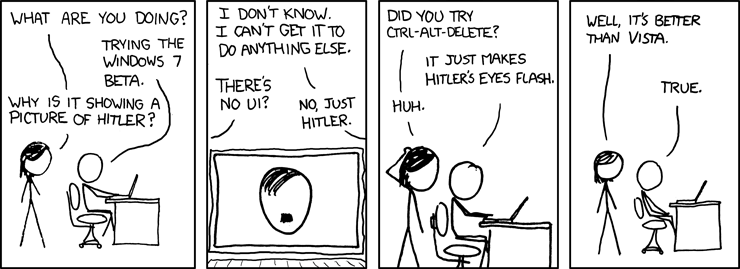 Microsoft has done something new with their new version of Windows. They are allowing people to download a beta copy of their upcoming new Windows 7 operating system. While this is likely a reaction to the tepid reception that their current operating system received, it's a refreshing and forward thinking thing for Microsoft to let people take a look at their software and play around with it before plunking down dollars for it. But this being Microsoft, the download process is full of hoops to jump.
First you have to get a Windows Live ID. Fine, Microsoft has been trying to get people to use this service as a single log-on for websites for a long time and it actually has a useful purpose as it can reduce the number of usernames and passwords that you have to remember if it catches on with a lot of websites and services. Of course, Google has pretty much the same service and it's way more popular than Windows Live (I can actually go to a lot of websites and use Google Checkout to buy things through my Google Account but have never seen a website that allows you to buy things through Windows Live) but I digress.
The real annoyance about downloading the Windows 7 Beta is that it doesn't support web browsers like Firefox or Chrome. You have to use Internet Explorer to download it and you have to install an ActiveX extension in order to download the Windows 7 Beta. Huh? I had barely gotten a third of the way through Slashdot's Windows 7 discussion before finding direct links to disk images for Windows 7 residing right on Microsoft's servers. Just out of curiosity I clicked on one of those links and it started downloading right away. Thanks Microsoft.
Interestingly enough, the direct linked download is downloading much more slowly (Firefox estimates that the download will complete in anywhere from ten to twenty hours) than the download that went through Microsoft's hoops and is downloading through an ActiveX control (the download manager installed by the control estimate that its download will complete in about two and a half hours). So there is a method to Microsoft's madness after all. Poking around the download manager a little more shows that it is making four connections to make the download. Kewl.
It looks like Microsoft is using this ActiveX control to break up the original file into pieces which it downloads through different servers, tracks them, and reassembles them on my PC. Congratulations Microsoft, you've invented Bittorrent, a technology which has been around for years and which is currently being used to pirate your software. Maybe if you had actually used this technology for allowing people to download music and video instead of for hiding your beta software behind it, you might have become the media powerhouse which Apple is today.
Friday, September 26, 2008
A Tip For Old Gamers With New Computers
 One of the few things that really makes Vista stand out from previous versions of Windows is the cool Aero 3D interface with its flippy windows and thumbnails of all your applications. Unfortunately, the Aero interface is a huge resource hog. I'd been having performance problems running Diablo II with Direct3D on my new HP laptop so I tried running it with DirectDraw. This solved the performance problem but created a new problem -- suddenly it now took Diablo II several minutes to start up. It wasn't ideal but I lived with it for a while.
Suddenly one day, the Aero interface disappeared for some reason (I think it was a related to a new video driver that I installed) and suddenly Diablo II was starting up instantaneously and running great in Direct3D mode. So I did a little experimenting and found a familiar looking dialog box in the Window Color and Appearance item in the Personalization application under Vista. This box made it easy to switch between the different color schemes in Vista. In other words it made it easy to turn the Aero interface on and off.

With a little more experimentation, I realized that it was easy to find this handy little dialog box. Just create a shortcut on your desktop with the following command line: "C:\Windows\system32\rundll32.exe" Shell32.dll,Control_RunDLL desk.cpl,Appearance,@Appearance
Every time you click on this shortcut the Appearance Settings box will appear and you can easily switch off the Aero interface so your games will run at full speed.
Sunday, July 13, 2008
Windows for Warships?
 Slashdot links to a disturbing and slightly sensationalistic article about the many unconventional uses of Microsoft Windows. These says everything from ATMs to warships use an embedded version of Windows and a lot of people who hate Microsoft hate this fact. But ultimately, they do have a point. Windows is overkill for many of these situations and its buggy enough that I can't help but wonder about what sort of mayhem can happen when someone hacks an ATM or worse yet, a US Navy "Smart Ship."
Subscribe to:
Posts (Atom)


