Showing posts with label usability. Show all posts

Sunday, November 7, 2010

Palm Drops Classic, Why It Matters.

Two weeks ago MotionApps, the developers of the Classic PalmOS emulator for webOS, announced that they were discontinuing Classic due to a dispute with Palm:

We are sad to announce that Palm has removed Classic’s ROM from the new webOS 2.0 device ROM which will result in Classic not working if utilized with Palm’s new webOS 2.0.

This is contrary to our agreement with Palm and was done without our approval or consent. Based on this action, MotionApps will immediately stop selling Classic. However, as a courtesy to our clients, we will continue to support existing Classic customers on webOS 1.x for the immediate future.

It's certainly a disappointing development for users of old school PalmOS apps like myself. But does it really matter? The truth is that I already have webOS replacements for most of my PalmOS apps. But a lot of these webOS apps are inferior to their PalmOS counterparts. Additionally, there are many PalmOS apps which still do not have webOS equivalents. And a lot of the PalmOS apps which have transitioned to webOS are still not ready for prime time. Finally, a lot of developers who made popular PalmOS apps are simply not interested in developing for webOS because its development tools are not mature enough yet.

While Palm has worked hard to foster developer interest, they are facing an uphill battle. Currently the webOS App Catalog has roughly 4300 apps. Add in the apps in Palm Web and Beta feeds and that number jumps to well over 5000. But Apple's iOS has 250,000 apps and Google's Android has 140,000 apps. And this isn't just a matter of quantity over quality, there are many unique and powerful apps which are not available to webOS users. A lot of this stems from limitations in the APIs of webOS and in the hardware of webOS phones. And that's all the more reason why Palm needs the Classic as a bridge between the limitations of webOS and the power of PalmOS. More than 30,000 PalmOS apps can be run in Classic.

Ultimately, it does Palm no good to further alienate a group of developers which were already upset with the move from PalmOS to webOS and who are attracted by the much greener pastures of Android and iOS. MotionApps has handed over the Classic source code and intellectual property rights to Palm, so Palm has all it needs to restore and support Classic themselves. There would seem to be no reason why they couldn't put it back in a future version of webOS.

So it makes a lot of sense for Palm to support Classic. They already go out of their way to support webOS and Homebrew developers. And they are working on tools to allow developers to build "hybrid" apps which will use both traditional C/C++ code and the HTML/Javascript code that powers webOS apps. A PalmOS emulator like Classic, could be another tool for Palm to get apps on to their platform.

Classic wasn't perfect. It was slow and it was the only app on webOS that could actually crash my phone. And using felt like living in a mobile computing ghetto—PalmOS apps ran inside Classic and couldn't be used as cards and you couldn't copy and paste between PalmOS and webOS apps. But it did allow access to a great number of apps which otherwise wouldn't exist for my phone or which are better than the apps which are available to me.

Now that Palm has full control of Classic and a perpetual license to PalmOS, they can fix all that if they want. They can make PalmOS apps run seamlessly as cards alongside their webOS counterparts. They can make it possible to copy and paste between PalmOS and webOS apps. They can even "skin" PalmOS apps to make them look more like webOS apps. For that matter why not add a PalmOS section to the webOS App Catalog where users can install legacy PalmOS apps? But all this will all take time and money—two things that I don't think Palm wants to spend on PalmOS. Having said that, Palm is still developing webOS anyway and it makes more sense for Palm to expand its capabilities instead of contract them.

I've seen a lot of comments about DOS and Windows XP bandied about in discussions about Classic. And Microsoft's history of support for Windows XP is actually a pretty good example of how to handle aging software—an example which Palm would be wise to follow. Up until last month you could still buy a PC with Windows XP preinstalled nine years after it debuted. (And you can still "downgrade" a PC with Windows 7 to XP.) Microsoft supported Windows XP with Service Pack 2 until July 31, 2010 and still supports Windows XP with Service Pack 3 to this day. For almost a decade, Microsoft has supported Windows XP with the result that it remained their most successful software program even long after it became obsolete.

Now compare this to what has happened with Classic. On October 19, Palm introduced webOS 2.0. By October 25, MotionApps withdrew Classic from the webOS App Catalog accusing Palm of breaking its agreement with them. That's not the kind of orderly transition from one platform to another that engenders user or developer confidence.

While Classic represents a tiny subset of the webOS user experience, there seems to be little point to removing a useful capability from it at a time when webOS is struggling to gain acceptance. The openness and freedom of the webOS experience is one of the things that distinguishes it from its competitors. At a time when Apple was trying to outlaw Jailbreaking and Google was challenging the legality of rooting Android, Palm actually made it easier to hack your phone. And Classic represented an example of that freedom—the ability to install and run "obsolete" software which you still found useful. For me the bottom line is that if I wanted a handset maker telling me what software I can and cannot use on my phone, I'd have gotten an iPhone.

With webOS 2.0, MotionApps drops Classic PalmOS Emulator in Palm's lap | PreCentral.net

Monday, November 1, 2010

Bible Readers for webOS

I had a very religious upbringing and I still go to church regularly. And I've carried some form of bible reading software with me since I installed a the original OliveTree BibleReader on my Palm III back in 1999. So when I got my Palm Pre, I was very interested in looking for Bible readers on webOS. With the the Pre entering its seventeenth month of existence, the development of software in this area gives a good overview of the growth and lack of growth in webOS.

I have tried to take a look at the various Bible apps which I've encountered on webOS and will review them in turn. While this software round up will not be exhaustive I will try to be reasonably thorough.


webOZ Mobile Apps has created a number of readers for various translations of the Bible, each of which is sold separately (for $1.49-2.99). In addition, webOZ sells other Bible study tools like dictionaries which can be accessed from their Bible readers. Each of these apps are simple, fast, and intuitive. The Scrolling is fast and smooth. Tapping on an arrow on the lower left corner of the screen activates an auto-scroll function. To the right is an arrow which scrolls a page at a time. And in the middle is an options button which drops down a convenient menu for highlighting text, bookmarks, copying text, email, and search.

Each reader presents the user with a clean, friendly screen which makes it easy to drill down to the book you are looking for. Chapters are a little different as they appear on a drop down grid at the top of the screen once you've chosen your book. Verses however are awkward, you can't drill down to the verse you are looking for, you have to scroll through your chapter to find it. Searching is fast and intuitive (the app begins to search as soon as you begin to type) but it requires an active connection to the Internet to work.

The fact that every translation is sold separately is both good and bad. On the bright side, you can take advantage of webOS's native multitasking to run multiple translations side by side. On the other hand, you do get the uneasy feeling that you are being nickeled and dimed by having to buy each translation. (But they are cheap, so it's not too bad.) More worrying is the fact that webOZ simply does not have that many translations available for purchase. I'm Latino and I grew up using the Spanish language 1960 Reina Valera translation a lot and as far as I know webOZ only offers the 1909 version which uses older sounding language. When I'm reading in English, webOZ presents me with the opposite problem, they have the older King James version but not the 1963 Modern King James version.

Overall, webOZ presents a nice stable of clean, easy to use Bible translations for the casual churchgoer. But more serious Bible students should probably look into something a little more powerful.
Photobucket


Photobucket

YouVersion (simply called "Bible" in the webOS App Catalog) started out as little more than app wrapper for mobile version of the website of the same name but recently their Bible reader has improved greatly both in terms of looks and usability. It's tight integration with the YouVersion website is potentially very useful for serious Bible students.

YouVersion presents a nice, clean home screen which allows access to wide variety of Biblical translations. Once inside, it is easy to switch between translations. There is also an attractive dark theme for low light situations. It is easy to drill down by book and by chapter but as with webOZ it is impossible to drill down to specific verse, except by searching for it. Search is fairly quick but noticeably slower than with the webOZ Bible readers which search as you type.

Tapping on a verse allows you do a wide variety of things with the text, including copy it to the clipboard. But most other functions—even creating a bookmark—require you to have an account with YouVersion. But you can email the text and look at Contributions (essentially crowd sourced notes about the verse you've selected) made by YouVersion users. If you do have a YouVersion account, you can add Contributions of your own and share them with other users.

YouVersion is a fairly powerful Bible app but a lot of that power is due to its tight integration with the YouVersion website. So while hardcore Bible students will likely find it to be a valuable tool, more casual users might not be willing to commit to joining yet another website.

Photobucket


Photobucket

Bible Reader Plus ($1.49, free version available) is an app wrapper for the mobile version of excellent BibleGateway website which boasts "over 100 versions and 50 languages." But it does have a few interesting tricks. Once you've selected your verse, what you can do with it depends on the format of the Bible. The bibles come in three formats: web, database, and audio. Web bibles can only be copied and pasted like ordinary text you come across on the web. But text database and audio bibles can also be highlighted and shared online through, Facebook, Email, and SMS. And audio bibles can also, as the name implies, read the text back to you.

Bible Reader Plus also has tools for creating a Bible study plan with reminders, journals, and reports. Its web bibles also allow you to type out the book, chapter, and verse you are looking for and drill down to it which is a feature that other readers lack. Another nice feature is that it can open multiple cards so you can run several different translations side by side.

The biggest advantage of Bible Reader Plus is the sheer number of translations that it offers. But its many translations have an inconsistent look and feel and not all of its features can be accessed in every translation. As a result, Bible Reader Plus works best as a supplemental tool for serious Bible students or as a tool for casual users who occasionally look up a single verse.

Photobucket

BibleZ (Free) allows you download XML databases for a variety of translations of the Bible. The databases are quite large and don't always download nicely over 3G connections. They do however download well over WiFi . As with the webOZ offerings, you may not be able to find your favorite translation for BibleZ.

If you can, BibleZ offers the most attractive interface of the Bible readers I am reviewing here and allows you to switch between translations and drill down by book and by chapter easily via cleanly laid out menus and selection screens. As with most of the apps in this roundup, there is no way to drill down to a specific verse unless you do a search. And BibleZ is a little slower than the other apps to jump from its search results to a specific verse.

When BibleZ goes into landscape mode its interface elements disappear which is a nice feature when you just want to read. BibleZ also includes quick access to your reading history, notes, and bookmarks. It also allows you to tap on a verse to add a bookmark, note, highlight, and to either copy or share a verse through email or SMS.

All these features make BibleZ a very attractive and powerful app. The only thing holding it back is is the number of tranlations—BibleZ has a lot of them but it simply can't match the number of translations that online bible based apps like YouVersion and Bible Reader Plus boast.

Photobucket

Photobucket

Simple Bible (Free) Like BibleZ, Simple Bible depends on databases to load its biblical translations. Simple Bible has fewer databases and a clunkier interface. When you first start Simple Bible, it shows a splash screen with "What's New" and "Donate" buttons. This screen can be disabled, as can the the pop up encouraging you to download the Ten Commandments companion app. Once these screens are disabled, Simple Bible presents you with a list of your Bibles and a link to download more within the app. As with BibleZ, the databases are large and best downloaded over a WiFi connection.

Once you have opened your bible, a button toggles between the Old and New Testaments and menus allow you to select books and chapters quickly but you have to scroll to your verse or search for it. Bookmarking is rudimentary and clumsy. But Simple Bible does have one nice feature. You can tap on the screen and all the interface elements disappear, allowing for distraction free reading in either portrait or landscape mode.

Overall Simple Bible is something of a misnomer, while it is a nice free app it is also clunky and tends to get in your way more than it helps.

Photobucket

Photobucket

OliveTree BibleReader is an old school PalmOS program which runs well inside the Classic PalmOS emulator. I saved this program for last not because it's the best (even though it is) but because Palm's recent decision to stop supporting Classic means that the days when webOS users can run PalmOS apps on their phones may be numbered. Nevertheless, Classic still runs on the Palm Pre, Pixi, Pre Plus, and Pixi Plus for the moment at least so I'm including OliveTree in this roundup.

BibleReader uses databases for its biblical translations which much be purchased and installed separately from the reader in Classic. Some of these translations are free but others can be quite expensive. But OliveTree leverages the maturity of PalmOS to create an app with the kind of power and versatility which blows away the webOS apps in this roundup. In addition to bibles, BibleReader can also open commentaries, dictionaries, ebooks, maps, and more.

Every aspect of BibleReader can be customized with preferences for desktops, fonts, toolbars, and scrolling all of which can be tweaked by the user. You'll notice most of the apps in this roundup have one format the verses while YouVersion uses a different format which groups verses into paragraphs. As far as I can tell, the verse format cannot be changed in any of the webOS apps. But in OliveTree BibleReader this format can be changed.

Even though it looks pretty ugly next to the beautiful webOS apps in this roundup BibleReader is simply much more robust than its webOS competitors. It can remap the virtual buttons in Classic to control any of BibleReader's features. And BibleReader has a lot of features. Its bookmarks menu is better and easier to use than the bookmarking feature of any of the other apps in this roundup and it can be edited, saved, and exported as a file. It has menus for switching between translations and for quickly accessing your reading history.

BibleReader has a versatile and customizable verse chooser which allows you to drill down to a specific verse quickly and easily. And if you use one of the BibleReader desktops which support a "live toolbar" you can actually tap on any chapter or verse and select a new one from the verse chooser.

BibleReader's biggest weakness is that it was originally designed for a stylus-driven screen. Some of the screen elements are quite small and can require some pinching and zooming for large handed users. Similarly, the fact that it must run inside the Classic emulator is another weakness for BibleReader. Classic is slow to load and is about to be abandoned by Palm. So while in many respects BibleReader blows away the competition an one very critical respect, it isn't even in the race.

Photobucket

Photobucket

Photobucket

Conclusion: It's disappointing to see Palm abandon its Classic emulator so soon. While there are some good apps in this roundup, none of them have the power and flexibility of BibleReader and a similar story can be told about apps in other categories. Nevertheless, it would be a mistake for some who doesn't already have a large investment in PalmOS apps to try them right now.

As for the webOS apps, if it has your favorite biblical translation, BibleZ is your best bet. It has a great combination of flexibility and power. If you don't have a favorite biblical translation go with one of the webOZ translations. It's simple, fast, and perfect for casual users.

Friday, September 17, 2010

Will the New iPod Nano Be the New Wristwatch?


The new iPod Nano hasn't been received as well as its predecessors by some people. But for others, it has been something of a revelation. The idea that you can actually replace your wristwatch with an MP3 is very appealing to a lot of nerds, myself included. In a way it represents the arrival of the legendary Dick Tracey watch. While a few companies have actually tried to create a high tech watch, most of them have been wildly impractical. They always too big, ugly, expensive, and lacked the battery life that people expect from a watch.

But perhaps the time has come for the iPod watch. I haven't worn a watch on a regular basis in over five years, because I always carry a phone or a PDA or an iPod around with me anyway and they all display the time. Moreover I have been "trained" to recharge modern gadgets on a regular basis, so battery life is less important to me. And the iPod Nano is small, looks great, and fulfills multiple needs: it can be a watch, an MP3 player, and it even has a pedometer and FM radio. More importantly it is something that I would use every day, I'm always listening to music, podcasts, and audiobooks and this device is as good as any other for that purpose.

In fact the new iPod Nano has everything it needs to be an "invisible" piece of technology. Everything except Bluetooth. Why does it need Bluetooth? Because with Bluetooth, you can use wireless headphones with the iPod Nano. Without Bluetooth, you need to attach a set of head phones attach to long wires. And these wires would attach to your wrist which seems very awkward if you are going to be walking around with one of these things. You could also use a Bluetooth dongle, like the Nike+ sensor but that would make the pretty little Nano bulky and probably ugly, defeating the purpose of a Nano watch.

So close. Maybe a Nano pocket watch? Of course you could always switch it from a watch band to a key chain or even use it as a tie clip whenever the mood struck and that's pretty cool too.

Portable Apps—Now With Updates!

Once upon a time, it was possible to just drop a program on to your hard drive and just run it. At worst you might have to unzip a group of files into a folder and just run your program. But these days software is so complicated that it insinuates on putting pieces of itself on every corner of your computer. This often makes our computers slow, buggy, and hard to upgrade.

A few years ago, some people began taking advantage of the growing sizes of USB flash drives to create a new generation of software which has been helping fight this trend. Portable Apps can be installed on a flash drive and allow you to work with your own files and your own applications on any computer without making any changes to the computer which you are using. It's perfect for people who need to borrow someone else's computer or for people who often find themselves having to schlep files from one computer to another. For that matter, it suddenly occurs to me that users of files synchronization services like Dropbox would do well to keep a few frequently used portable apps in their Dropbox and cut the flash drive out of the equation.

I always keep a flash drive with a Portable Apps installation on my key chain just in case I ever find myself needing to do something on a computer but don't have one with me. But my biggest problem with this—indeed with the very concept of Portable Apps—is that software gets updated from time to time and it's very hard to keep up with software updates, especially when you have dozens of portable apps which are constantly being updated.

Enter PortableApps.com Platform 2.0. The latest version of the Portable Apps software brings several interesting changes, like themes for customizing the look of the Portable Apps menu. But more importantly, you can now check for updates to your apps and Portable Apps will download and install them automatically. PortableApps.com Platform 2.0 is currently in Beta so caution is advised. In my own personal testing, PortableApps.com Platform 2.0 was able to update all but one (PNotes) of the thirty-nine applications on my my SD Card and another app (Notepad++) needed to update some of its plug-ins the first time it ran. Everything else ran perfectly. While it wasn't perfect (hence the "Beta" tag) this was certainly preferable to downloading and installing thirty-nine programs.

Overall, PortableApps.com Platform 2.0 is a welcome update to a very useful application platform which itself was already a welcome addition to any large flash drive.

Sunday, August 29, 2010

As Homebrew Reaches New Heights, webOS Needs to Grow to Accommodate It

Photobucket

Photobucket
My Palm Pre is fourteen months old and I still can't find a phone that can replace it. While I have had plenty of opportunities to play with Sprint's Evo 4G and am eligible to upgrade to it; every time I handle it my reaction is the same. I love the hardware but can't help wishing that its Android operating system were half as elegant and as usable as the webOS.

One of the things that has kept me so enamored with webOS is the Homebrew developer community that sprang up around it shortly after the Pre was released. Is your phone too slow? You can overclock it. Need an easy way to block unwanted phone calls? There's a patch for that. Not happy with your Calendar? There's a patch for that too. Ever wish you could use your phone's flash LED as a flashlight? There are actually several patches for that. Not happy with the Pre's messaging app? There are fifty patches for that.

One recent example of the power of webOS Homebrew patches is Advanced Configuration for App Launcher. This patch is a mouthful and so is the list of improvements that it adds to webOS's spartan App Launcher. It also exposes how bad most modern phones are at the seemingly trivial task of launching apps.

Back in the days of PalmOS PDAs and phones like the Treo, the app launcher was a relatively simple application but in comparison to the webOS launcher it is far more powerful and sophisticated. It allowed users to easily organize their apps with categories that could be added, deleted, and renamed. And there were numerous third-party launchers available for PalmOS which provided users with a wealth of customization options.

The webOS launcher by contrast comes with a measly three unnamed screens with no visible way to create more. (I'm oversimplifying things for the sake of the argument since webOS's Universal Search feature does make it easy to drill down to your apps by typing out the first letter or two of their names but do keep in mind that in the case of the Palm Pre, the keyboard is often hidden beneath its slider which adds one more step to your searches.)

And the situation on other platforms, the situation is not much better. Android borrows a page from desktop computers by shoving all of its apps into its launcher but allowing you to clutter your phone's home screens with shortcut icons. And it further complicates things for users by allowing each handset maker and cell phone carrier to customize the Android user interface, tweaking things just enough so users can't always just jump to a new Android phone without relearning how to navigate through its UI. Apple's IOS4 is the most mature of the modern smartphone platforms and has the most advanced launcher. With multiple home screens, folders, and multi-tasking; IOS4 approaches the power and ease of use that PalmOS had almost a decade ago.

The situation with application launchers is indicative of the atmosphere in which the webOS Homebrew community is operating. Modern smartphone OSes are powerful but they have also thrown away a lot of little things that made older smartphones like the Treo so easy to use and powerful in their own right. In the year since the Pre came out, numerous webOS patches have been created just to improve the launcher: patches for creating, naming, and organizing launcher screens; for hiding and unhiding apps; and for making it easier to navigate through app screens. Advanced Configuration for App Launcher brings all of these tweaks under one roof. It allows you add and delete named pages to the launcher, creates tabs for easier navigation between screens, the list of features goes on and on—but more importantly; this patch makes it easy to turn features on and off; so your launcher can be as simple, or as complex as you wish.

Photobucket
While Advanced Configuration for App Launcher is a potent example of how a handful of hackers working in their spare time can build powerful software for webOS, it also points to the limitations of what Homebrew can accomplish. This patch has been a huge pain in the ass to install in recent days. And since it is being updated frequently, it has to be reinstalled a lot. And the author of the patch even warns you that it conflicts with a lot of other patches. In order to get Advanced Configuration for App Launcher to install, I had to use the Emergency Patch Recovery utility to uninstall all of my patches and reinstall them one by one, beginning with the problem patch.

While in the past I haven't minded wiping out all my patches—I even appreciated the opportunity to rethink how I use my phone and which patches I want to install. But I don't want to have to do this every time one of my patches is updated.

And this problem is becoming more common. As the number of webOS patches grows, the number of potential conflicts between individual patches grows. While webOS Internals and other Homebrew developers have worked hard to create tools to make the patching process as painless as possible, there is only so much that they can do. Sooner or later, it will become necessary for Palm or perhaps HP to get involved with the Homebrew community beyond just offering gentle encouragement.

Many webOS patches are simple hacks which should have been in webOS from day one. Palm should be looking at the Homebrew patches that are out there and adding some of them to webOS. They should also create some sort of framework which will make it easier to add little tweaks (maybe HP-Palm can call them "extensions") to webOS without restarting the UI. As HP prepares to build a wide variety of devices based on webOS, such a system might even make it easier to customize webOS for use on a variety of form factors.

Sunday, July 11, 2010

KeyBoss - PreCentral Forums

Photobucket
One of my favorite apps on my old Treo phones was KeyCaps a utility which allowed me to capitalize letters and enter function symbols without using the phone's shift or alt keys. KeyCaps greatly speeded up my input and was one of the apps which I really missed when I moved to my Palm Pre. Now KeyBoss is recreating that functionality on webOS. While KeyBoss is currently in Beta and should only be installed by advanced users, I have tried it and it works well. This should be a must have utility for webOS homebrew users once it becomes available the main Preware feeds. KeyBoss - PreCentral Forums

Wednesday, June 9, 2010

Internalz, a File Manager for webOS

Internalz
When I reviewed zcorder I complained that this voice recording app has no way of managing recordings while noting that you can always use Internalz to browse through your recordings. After having played around with it a bit, I have to say that I'm pretty pleased with Internalz. I can move, copy, delete, and rename my recordings fairly easily and organize them by creating new folders for them.

File management is something we all have to do with our computers and as more and more of our data starts migrating to our mobile phones, a good file manager will become increasingly necessary for them as well. Internalz works well as a file manager. I would probably like more sharing options, like the ability to email files. But overall, this is a good, solid choice for managing your files.

Saturday, June 5, 2010

UberCalendar, Smart Up Your webOS Calendar

One of the shortcomings of the Palm Pre and Pixi the calendar application. While it is clean, simple, and arguably more powerful than its counterparts on the iPhone and Android; long time users of PalmOS can be forgiven for thinking that the webOS calendar feels dumbed down. Enter UberCalendar. A Homebrew patch for the webOS Calendar app, UberCalendar adds a number of enhancements to the calendar such as including the subject of an event in week view, more reminder times, the ability to remember and open the last calendar view when the Calendar app is reopened, buttons and shortcuts for entering new events, and a shortcut for launching the excellent Agenda Homebrew app which provides an at a glance view of all your upcoming Calendar entries. These enhancements along with others make the webOS Calendar more powerful and more pleasant to use.

The UberCalendar just debuted and is a little rough around the edges. One example of this is that UberCalendar supports the use of icons for events but these icons must be downloaded and saved separately on your phone's media partition. While this gives you more options for customizing your Calendar, it can be confusing for less advanced users. But then again, Homebrew software is by definition software for advanced users. More importantly, even with its current shortcomings, UberCalendar is the best add-on for the webOS Calendar available and is a must have for anyone who wants to get more out of their phone's calendar.

Once again UberCalendar is a Homebrew app and is not available through the official Palm App Catalog. It can be installed through Preware or with WebOS Quick Install.

Saturday, May 8, 2010

zcorder Brings Voice Recording to webOS

Photobucket
One of the major omissions from webOS phones like the Palm Pre and Pixi is a lack of a voice recorder. While MotionApps has made its Voice Memo app a free add-on for users of its Classic PalmOS emulator, it has the disadvantage of needing to be run from inside another relatively slow-loading application. Worse yet, I personally have never been able to get Voice Memo to work properly on my Palm Pre.

I've never been a huge user of this feature but I do miss it. And some people swear by it; so the arrival of zcorder onto the webOS Homebrew scene should be welcome.

Zcorder records both voice and sound from other running webOS applications. It is a very simple application. Your recordings are saved as MP3 files to a folder on your phone's internal memory and while you can browse them when you connect your phone to a computer in USB mode or use the Homebrew app Internalz to browse through them but you cannot manage your recordings in zcorder as you can with a true "voice memo" application.

But it works and for now it is the best bet for voice recording on webOS.

Zcorder is a Homebrew app and is not available through the official Palm App Catalog. It can be installed through Preware or with WebOS Quick Install.

Friday, May 7, 2010

Yahoo Thinks it's Still 1998

Gizmodo posted recent Yahoo ad where they take aim at Google: Yahoo Bitch Slaps Google In $85 Million Ad Campaign - Yahoo vs google - Gizmodo. I found the ad to be very striking but perhaps not in a way that bodes well for Yahoo. The thing that struck me was how retro it felt. Yahoo is basically promoting itself as a "web portal" even if the words never appear in their commercial. And for good reason, web portals were wiped out in the early 2000s by the bursting of the Dotcom bubble and by a new search engine called "Google."

Portals were all the rage in the mid to late 90s. They were huge, bloated pages that expected you to slog through tons of ads and links just to type in a few search terms. The result was huge, slow loading home pages at a time when most people still connected to the Internet through relatively slow dial-up modems. But they had "everything you need in one place"—never mind that if all you want is one thing, you'll have to wait for everything else to load and put up with numerous distractions.

And now Yahoo is for all intents and purposes trying to bring the concept back. The truth is that they never really abandoned the concept. When Yahoo started out it was more of a directory of websites than a real search engine. And they've stayed true to that concept even as the rest of the Internet abandoned it.

The bottom line is which page looks cleaner and easier to use?

This one?


Or this one?


Good luck Yahoo. I hope this turns out better for you than it did for these guys.

Thursday, May 6, 2010

Brightness Unlinked

Photobucket
Brightness Unlinked is a Hombrew app which solves two common problems for users of the Palm Pre.

There is no way to adjust the brightness of the Palm Pre's keyboard independently of the screen's brightness. Normally this is not a problem but sometimes—particularly in low light conditions—you want to turn down the brightness of the Pre's screen as much as possible. But when you do this, the backlight on the Pre's keyboard can become so dim that it becomes hard to type. Enter Brightness Unlinked. With Brightness Unlinked running, you can crank up the lighting on your keyboard while cranking down the lighting of the screen.

But for me the best feature of Brightness Unlinked is the fact that it can turn off the Pre's screen when it is sitting on the Touchstone charger. In theory, the Pre can double as a bedside clock while sitting on its charger but in practice its screen—even at its lowest level—is far too bright for anyone who wants to get a good night's sleep. So while you may never find yourself typing away on your phone in gloomy twilight, Brightness Unlinked is a must have app for anyone who keeps their Palm Pre by their bedside.

There is also a patch which will allow Brightness Unlinked to run every time you restart your phone but I found that it seemed to make the phone sluggish when you are low on memory. I never quite figured out if it was because of the patch or simply because my Pre was low on memory. But in any case, I found the patch to be rather redundant since Brightness Unlinked can reside the webOS Dashboard and can continues to run even if you throw away its card.

Brightness Unlinked is a Homebrew app and is not available in the regular Palm App Catalog. It can be installed through Preware or with WebOS Quick Install.

Friday, March 5, 2010

Google Reinvents Graffiti

Google has added a new feature to Android which looks a lot like an old feature from another mobile OS. Palm's old PalmOS PDAs had stylus-based input system called "Graffiti" where you would enter characters based on set of predefined pen strokes. It worked very well for years until the emergence of smartphones required Palm and Handspring to adopt keyboards for their devices. Add a long lawsuit by Xerox and Graffiti disappeared into the mists of gadget history.

Sort of. The idea of Graffiti remains popular enough that there is even a version available for iPhones. So it was probably only a matter of time before someone tried to bring it to Google's Android OS. That someone turned out to be Google itself which recently released a Gesture Search application which allows you to run searches by simply drawing letters. This is essentially what you did with the old PalmOS Graffiti.

But Gesture Search is a single standalone application while Graffiti was an essential part of the PalmOS and could be used with every PalmOS application. In fact even after Palm abandoned having a dedicated Graffiti input area for its Treo phones, it was still possible to install an app which would allow you to enter Graffiti strokes directly on the phone's screen.

That has gotten me to think about webOS on my Palm Pre. While there is a virtual keyboard available for webOS, there is nothing like Graffiti or even Gesture Search available for webOS. And that's disappointing because after all, Palm was the company which made this sort of input work in the first place.

And I think that Palm is uniquely suited to make it work again. Palm already has the code to Graffiti and Graffiti II—the successor to Graffiti which Palm introduced in part because of the Xerox lawsuit. And Palm has a its dashboard notification system which would be a convenient place to keep the controls for a Graffiti-style input system. So there really is no reason why Palm couldn't create another version of Graffiti and have it work on the entire operating system.

I used Graffiti for years on Palm PDAs. And I've used smartphone keyboards for years. But I was never really able to get used to using virtual keyboards which is one reason why I never got an iPhone. Now if I could have Palm's old Graffiti writing system back and have it live in my Palm Pre's dashboard, that would be a great alternative to sliding open my Pre when I only have to enter one or two characters.

Official Google Mobile Blog: Search your Android phone with written gestures

Wednesday, December 23, 2009

Hurry Up and Wait—Palm's Update Cycle Slows Down

Ever since Palm came out with its Pre phone, they have been updating its webOS operating system approximately once a month. Sometimes the updates have been small and sometimes they can introduce bugs. But even so, it was OK for me since there would usually be another update just around the corner. Now with their latest update which brought webOS to version 1.3.1, the update cycle has apparently slowed down. webOS 1.3.1 came out in mid-November and now we are nearing the new year with precious little word of another update. While normally a delay in updating webOS might not be a problem for me but webOS 1.3.1 has unfortunately introduced a rather serious bug which causes Motionapps' Classic emulator to be very unstable. Worse yet, just running Classic now can leave my Pre so sluggish that I have to reboot it both before and after using this program. And just to add insult to injury, apparently Motionapps has already fixed this bug but can't release the fix until Palm does its next update.

A perfect storm of incompetence. Suddenly the new Palm is starting to look a lot like the old Palm.

Classic Crash

Friday, October 16, 2009

In Praise of Hard Buttons

SAN FRANCISCO - OCTOBER 21:  The new T-Mobile ...Image by Getty Images via Daylife

LAS VEGAS - JANUARY 08:  A new Palm Pre smartp...Image by Getty Images via Daylife

Winter hasn't exactly come early to Chicago but it is unseasonably cold right now—cold enough that I've had to break out a jacket and gloves. This kind of leaves me in a bind gadgetwise. I still love my Palm Pre and am satisfied with its little sliding keyboard but the cold weather makes it less useful when I'm out in the cold. While the Pre is a slider phone a perfectly usable little keyboard, when the slider is closed the Pre is basically all screen with a single button that does only one thing. Other than turning it on and off and changing the volume, all other interaction with the Pre is through its screen. Normally this is no problem—in fact it's normally quite enjoyable. But when you are wearing gloves suddenly it becomes impossible to interact with the Pre.

Now contrast that to my older T-Mobile G1. The most recent firmware update gave this phone a new lease on life by making it fast enough to be usable again. And now the cold weather is is making it a lot more relevant for me because it has something that the Pre lacks—real hardware buttons. The G1's trackball is very responsive and allows me to interact with the phone quickly and efficiently. The home button allows me to get to the G1's "desktop" and access my shortcuts. And finally, the back button helps me get around the phone even faster.

I've always felt that the G1 was something of a evolutionary odd duck. Not as pretty as the iPhone or as elegant as the Pre but an interesting phone because it shows the potential of Android as a phone OS. With the release of the Pre and its webOS operating system, suddenly the potential of Android doesn't fascinate me aas much as it used to. But the ability to scroll through a bus tracker web site on a cold day without having to take off my gloves doesn't need to be fascinating, it just needs to be quick and efficient.
Reblog this post [with Zemanta]

Tuesday, October 6, 2009

My New Old Phone

Ever since upgrading to my Palm Pre, I haven't had much use for my T-Mobile G1. Sure, I kept it because sometimes it's useful to have a second phone but for the most part my G1 has been semi-retired. But a funny thing happened last week. Google pushed out an update to the G1's Android operating system.

I was pleasantly surprised as a rumor had been going around the interwebs that the G1's hardware was too puny for the latest Android update. More importantly, the update seems to have fixed the G1's number one problem. It has suddenly become a much faster device. It's not as fast as my Pre is on its best days but it's definitely competitive.

This is a pretty exciting development. The G1's problems had soured me on Android but now with its latest update, I'm starting to de-sour.

Classic Takes One Step Forward, Ten Steps Back

There is something of a compromise these days between gadget and software makers and their users. They put out incomplete gadgets and software and we put up with it because we think it's part of the price for getting to play with the latest and greatest. Witness the Beta label which clung to GMail for years. And it's not just with software. It took years for the iPhone to get a basic feature like cut and paste.

Similarly, Palm was able to release the Pre without certain features, like video recording, and with few native apps, asking its users to trust in its ability to update their phone. And certainly Palm has been good about updating the Pre with updates coming on a monthly, sometimes even weekly, basis. And they smartly made sure that one of the first third-party apps available for the Pre was Motionpps' Classic, an emulator which allows its users to run PalmOS apps.

For me, Classic essentially sealed the deal and made me get my Pre simply because I have used PalmOS apps like SplashMoney and HandyShopper for years and could now use them on my Pre. And while Classic isn't perfect, sometimes it crashes and freezes up and it has even crashed the entire phone on occasion. But generally it has been improving through updates.

Until now. With the recent 1.2 webOS update, Classic gained the ability to Hotsync to a desktop computer over wifi. A second update added the ability to sync over Bluetooth. And yet, I still haven't figured out how to make this sync work even though I frequently used both Bluetooth and wifi to sync my older Palm devices. This isn't too bad, I'm willing to be patient with MotionApps as they have promised to put up a FAQ to help users sync to their computers. But the thing that really bothers me is the fact that ever time I start up an app in Classic it pops up the following message:
Photobucket

Great, a nag screen for all my older apps. Perhaps MotionApps think they are helping users. Perhaps it's trying to cover itself legally. Or perhaps they just want them to badger software makers into joining Classic's certification program.

Either way it is annoying. It gets in the way of my work. And worse yet, it reminds me of Microsoft's obnoxious User Account Control in Vista. Sure it only runs the first time I run an app inside Classic but unless I keep Classic running all day long—something which given Classic's stability problems is not realistic—I will wind up seeing this message hundreds of times a day as I start and stop Classic and apps within Classic.

Another new addition within Classic isn't quite so bad as the nag screen but it is puzzling. I give you full screen mode:
Photobucket

Not much to look at right? All it does is hide the Pre's top bar, giving you exactly zero extra pixels because it merely replaces it with its own considerably less useful and less informative top bar. Now if full screen mode would collapse the virtual d-pad and buttons and give you full use of the Pre's 480x320 screen, it would be something which I've wanted since the Pre debuted. As it is implemented now, Classic's full screen mode is both pointless and useless.

For the first time since I got my Pre I'm an unhappy user. Ever since updating to version 1.2.1, my Pre has been slow and buggy and I can't pin-point the reason why. Classic is getting in the way more than it is helping. And at a time when Palm is ramping up its efforts to get more apps onto the Pre, webOS doesn't want to load more than fifty apps at a time.

Are these just growing pains for a young platform with a bright future or is it a sign that Palm has reached the limits of its ability to create something good and useful for its users. I deeply hope that its the former and not the latter.

Wednesday, September 2, 2009

The Palm Pre Gets An Onscreen Keyboard. Yay?

PhotobucketPhotobucket One of the reasons why I never got an iPhone was because I could never get used to its virtual keyboard. Still, once an onscreen keyboard became available for the Pre which was relatively easy to install, it made sense to at least give it a try. And the results were about what I had expected. While the ingenuity of the Virtual Keyboard is admirable (when tap the "Sym" button, you can scroll down and enter any symbol that the keyboard is capable of entering), it is ultimately too small to use comfortably especially in comparison with the Pre's slide out hardware keyboard.

There are also other problems. While the Pre's built-in error correction is fairly meager compared to that of the iPhone, it does come in handy for little things like putting apostrophes in contractions and automatically capitalizing letters at the beginning of sentences. This does not work with the Virtual Keyboard even though realistically, you will tend to make more typos with it than you would with the hardware keyboard—disappointing to say the least.

But the Virtual Keyboard does have its uses. It's great for pulling up recently visited pages and bookmarks in the web browser which usually come up after typing a couple of letters. It's a small thing but it is potentially very convenient since you no longer have to slide open the keyboard in order to type two or three characters.

More than anything else, the Virtual Keyboard makes me miss Palm's old Graffiti writing system. A fairly simple, easy to learn set of onscreen strokes which allowed users to enter information without any kind of keyboard, Graffiti was one of the things that got me hooked on the old PalmOS. And it would be a nice thing for some enterprising developer to try to bring to the Palm Pre.

Tuesday, September 1, 2009

As Palm Pre's App Catalog Grows, Homebrew Scene Exposes a Potential Achilles Heel

PhotobucketPhotobucket
PhotobucketIn the less than three months since its release the Palm Pre's App Catalog has grown from a little over a dozen apps to forty five. So while it's not growing as fast as its fans would like Palm seems to be moving in the right direction in terms of courting developers. Rome—and all major software platforms—were not built in a day. And for those of us who are impatient and technically inclined, there is always the Homebrew scene.

But it is the very popularity of the Palm Pre's Homebrew apps which expose a worrying concern. It seems that the Palm Pre limits the amount of space which it dedicates to storing applications. As a result, there is a limit to the number of applications which can be installed on the Pre. I have installed a lot of apps from the App Catalog and a lot of Homebrew apps on my Pre. All told, including the Pre's built-in apps, I have fifty-two apps on my Pre. And as a result, I often bump up against this storage limit and have to delete existing apps in order to install new ones.

When you consider the size of huge number of apps in the iPhone's App Store or even the Android Market, the problem with this approach is clear. There is no reason why I should be getting anything resembling an "out of memory" error on my phone when it still have three gigs of free storage space left. The original PalmOS in its heyday, had over 30,000 apps available for it and most of those apps are available for the Palm Pre thanks to the Classic emulator. So for Palm to have a limit on the number of apps that can be installed on its webOS devices like the Pre feels like a mistake which should be corrected sooner, rather than later.

Sunday, July 19, 2009

Homebrew Apps Provide a Fun Outlet for Impatient Pre Users

PhotobucketPhotobucketPalm recently released its Mojo Software Development Kit to developers. This is a good thing because I was getting sick of seeing only 30 apps in the Pre's app catalog. There will still be a wait as developers create and and submit applications to Palm for approval. In the meantime, the Classic emulator allows you to use most of the thousands of PalmOS apps that have been created over the years and there are always web apps which can be both fun and useful. And now, Homebrew apps created by hackers for the Pre are becoming both useful and easy to install.

The first app pictured here is Pretris, probably the best of the homebrew games available for the Palm Pre. A fairly simple but attractive Tetris clone for the Pre, Pretris is a good example of how the Pre's webOS allows for the rapid creation of fairly polished apps. In addition to Pretris there is also a pretty good homebrew Solitaire game available for the Pre.

Besides games there are also useful utilities available for the Pre. Translator and Currency Converter are probably my favorites among the homebrew utilities. Even though the installation tools are partially command-line based, they were fairly easy to install. (By contrast, I have yet to successfully install Palm's Mojo SDK, the damn thing keeps stopping and rolling itself back during the installation process.) And it makes installing your homebrew apps as easy as dragging and dropping them onto a desktop icon.

While it would be unrealistic to pretend that there is absolutely no risk to using this homebrew software, so far I have encountered no problems with the half-dozen or so apps I've installed. In theory the developer mode which the Pre has to be put into in order to enable app installation is a potential security risk but it is also fairly easy to enable and disable.

The speed with which these homebrew apps have sprung up is remarkable and bodes well for the future of application development for the Pre's webOS.
PhotobucketPhotobucket

Tuesday, July 14, 2009

Exanotes—The Future of Cloud Computing?

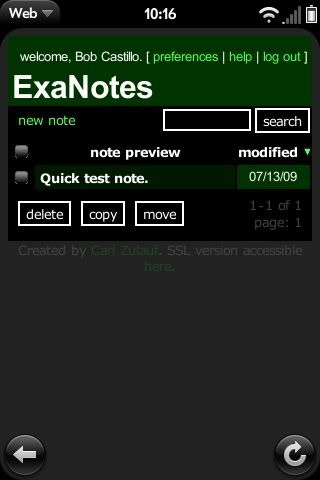
ExanotesI'm pretty happy with my Palm Pre but one of its shortcomings is in the Memos app. While it's a nice looking app, it is too simple, lacking such old-school PalmOS amenities as Categories or a List View. Worse yet, unlike the Pre's Contacts and Calendar, the Pre's Memos don't sync to anything. They are trapped on the Pre and cannot be edited on a desktop computer.

While I was able to import all of my old PalmOS memos into the Classic PalmOS emulator, again I have a situation where my memos are trapped because Classic cannot yet sync to anything. And since Classic cannot exchange cut and paste data with normal webOS apps, my memos are in a sense doubly trapped—on inside Classic semi-isolated from the rest of the Pre's data and unable to sync with the outside world.

Today I stumbled on to an interesting web-app. Exanotes is a web-based note-taking service. While it does offer a clean, simple interface what stood out for me is the fact that the service it uses 256-bit AES encryption. Good encryption is one of the things which have been sorely lacking in "Cloud Computing" applications and may help assuage the fears of people who are worried about putting their data into the hands of a third-party website.

The author of the web service has stated that he wants to create webOS app which syncs with the web service in the background. This would eliminate the need for a desktop client as any computer with a browser can be the desktop client for a user of this service and it will still be protected by the user's password (just don't click on the "Remember Me" check box if you are somebody else's computer).

My only real concern regarding Exanotes is its scalability. Will it be able to support thousands or even millions of users trying to sync to it at the same time? Only time will be able to answer that question but for now I'm hopeful. Exanotes looks like what I want to hear when people talk about Cloud Computing and I hope it succeeds.

Exanote might be worth checking out for people thinking of moving from a PDA to a smartphone.