It's been up for about two weeks but I finally got around to viewing Palm's hour-long developer preview webcast on Palm Infocenter. To no one's surprise, it turns out that programming for Palm's upcoming webOS, the operating system which will power the Palm Pre, is a lot like programming for the web. The information was very basic but it looks like webOS will be very easy to program for traditional PIM applications like Calendars and Contacts.
But what about more elaborate applications? People keep asking about games but I'm thinking more in terms of other classes of applications. Suppose I want to write a Usenet client for the Pre? It would have to connect to a Usenet server on the Internet and download articles using the NNTP protocol and install them into a database on the Pre. That should be no problem for a decent programmer (it might be beyond my abilities but that's another story). But what about other tasks that a good Usenet newsreader needs to perform like filtering, sorting, and purging articles? Will it be doable on webOS and will it be fast?
Another question is how easy will it be to add things that Palm leaves out of the Pre. Specifically, I'm thinking about a PalmOS emulator and Graffiti support. While I understand Palm's decision to not support legacy PalmOS applications, that doesn't mean I have to like it. So how long will it take to get a PalmOS emulator to run on webOS? I don't suppose that an application like WINE which is not an emulator in the strictest sense but does allow Linux to run many Windows applications is possible for running PalmOS apps under webOS?
And would it be possible for an enterprising developer to add custom gestures which would allow for character input—in other words a replacement for the PalmOS's old Graffiti character recognition system? A year ago, this probably wouldn't have mattered to me but then I upgraded my phone from my Treo 680 to a T-Mobile G1. Suddenly, I found myself using my Palm TX a lot more for tasks where my G1's Android OS didn't measure up to the PalmOS. And thus I rediscovered Graffiti. It sure would be nice to have a webOS Dashboard that could pop up a Graffiti like input area for times when I only need to enter a few characters and don't want to open the Pre's keyboard. I'd probably never use it after a while but it would be nice to know that it was available.
Showing posts with label usenet. Show all posts
Showing posts with label usenet. Show all posts
Wednesday, March 11, 2009


Sunday, November 9, 2008
Googling Usenet
This is the sort of post which I must admit is basically just something I'm writing down so I won't forget about it. It's so nice that blogging allows me to treat the Internet as my own personal napkin.
If there is one program that I use more than any other on my computer, it's Agent. Well, I probably use a web browser, any web browser more than anything else just like everyone else. But after a web browser, I use Agent for both e-mail and for reading Usenet newsgroups. Now Agent is a pretty complex program and it has many little tricks which many people never use because they don't realize that it can do them.
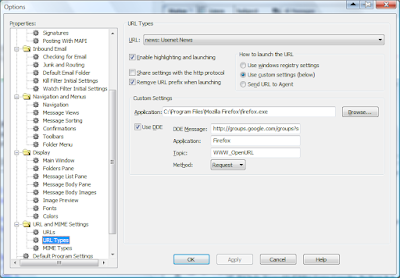
One such trick is the ability to launch your web browser and retrieve a Usenet post from Google's Usenet archive. This can be useful for older topics where you want to see the whole discussion as it happened.
Setting it up is a five step process:
This kind of Google integration has been available in Agent for years and it's a good thing because Google's own Usenet newsreader is pretty bad as is its search function. Luckily, there are a number of tricks which can be used for searching Google for old Usenet topics. One of the nicest, most overlooked features of Firefox is its Keywords feature which allows you to save a custom search template and then invoke it directly from Firefox's address bar. I have a number of keyword searches for Google's newsgroup archive.
Both of the searches below can be bookmarked and used to search for a specific Message-ID. Basically, they run the above trick I use with Agent directly from Firefox's address bar.
If there is one program that I use more than any other on my computer, it's Agent. Well, I probably use a web browser, any web browser more than anything else just like everyone else. But after a web browser, I use Agent for both e-mail and for reading Usenet newsgroups. Now Agent is a pretty complex program and it has many little tricks which many people never use because they don't realize that it can do them.

One such trick is the ability to launch your web browser and retrieve a Usenet post from Google's Usenet archive. This can be useful for older topics where you want to see the whole discussion as it happened.
Setting it up is a five step process:
- Under the Tools | Options menu item choose URL and MIME Settings | URL Types and select news:Usenet News as your URL type.
- Check the following items:
- Enable highlighting and launching
- Remove URL prefix when launching
- Use custom settings (below)
- Click Browse and point Agent to your web browser. Not every web browser works nicely with Agent to launch itself and go exactly where Agent tells it to go. Firefox works perfectly, Chrome does not. I haven't tried this trick with recent versions of Opera or Internet Explorer but based on previous experience, I would expect them to work.
- Check Use DDE. Use the message, http://groups.google.com/groups?selm="%1"
- Fill in the other DDE settings:
- Application: Firefox (or whatever the name of the browser happens to be)
- Topic: WWW_OpenURL
- Method: Request
This kind of Google integration has been available in Agent for years and it's a good thing because Google's own Usenet newsreader is pretty bad as is its search function. Luckily, there are a number of tricks which can be used for searching Google for old Usenet topics. One of the nicest, most overlooked features of Firefox is its Keywords feature which allows you to save a custom search template and then invoke it directly from Firefox's address bar. I have a number of keyword searches for Google's newsgroup archive.
Both of the searches below can be bookmarked and used to search for a specific Message-ID. Basically, they run the above trick I use with Agent directly from Firefox's address bar.
- http://groups.google.com/groups?selm=%s
- http://groups.google.com/groups?as_umsgid=%s
- http://groups.google.com/groups/search?safe=off&btnG=Search&sitesearch=groups.google.com&q=%s
- http://groups.google.com/groups/search?safe=off&btnG=Search&sitesearch=groups.google.com&q=%s&as_drrb=b
Thursday, October 30, 2008
Atlas of Cyberspace
A Usenet posting alerted me to a blog post which alerted me to the Atlas of Cyberspace, a colorful book which visualizes and explores the infrastructure of the Internet. If you are curious about the design of the tubes which bring you your cat pictures and spam, this free downloadable e-book is a must read.
Tuesday, October 7, 2008
Usenet, From Past to Present
 PC World has a nice article on the history of Usenet and its current state as many ISPs use the New York Attorney General's crusade against kiddie porn to drop or significantly water down their Usenet service. It's a good read and nicely explains that the elimination of Usenet service by ISPs has less to do with protecting children from porn and sexual predators and more to do with side-stepping legal challenges related to porn and copyright infringement. Binary Usenet newsgroups which allow users to exchange files are usually full of copyrighted music and movies (not to mention porn) and by eliminating them, ISPs avoid lawsuits by copyright organizations like the RIAA which love to sue people for "stealing" music and movies.
Removing binary groups supposedly also helps ISPs save on bandwidth but I don't think that this is the case. Most heavy binary users—the ones most responsible for driving up bandwidth usage on Usenet—will likely move to a third party Usenet provider if their ISP cuts their newsgroup service. And because these third party services tend to be better and faster than their ISPs service, these people will use them even more heavily than they ever used their ISPs Usenet service. And ultimately, the ISP will still have to move all of the bits to the end user even if they don't reside on their servers. My own intuition suggests that bandwidth usage will increase instead of decreasing.
But at least they won't get sued by the RIAA....
Thursday, July 31, 2008
PC Magazine Pronounces Usenet Dead—In Other News, PC Magazine is Apparently Still Alive
I suppose it was inevitable. Every so often, you see someone proclaiming The Death of Usenet. This time it's somebody from PC Magazine and much of the consensus at Slashdot is that he's right. In fact given the recent spate of ISPs dropping Usenet alt.* hierarchy at the behest of the Attorney General of New York, I'd say that the Death of Usenet article was a little late this time around.
And while all this is going on, here I am with a backlog of literally thousands of still unread Usenet messages. Thankfully Usenet clients are a lot more powerful than web posting boards like Slashdot and it is pretty easy to clean up most of the Usenet clutter using kill filters to eliminate trolls and spammers. I jumped ship from my ISP's Usenet feed to a third-party Usenet provider years ago so for now, the culling of Usenet by ISPs doesn't affect me. But it is fascinating to see history—or rather the recitation of history—repeat itself. The conventional wisdom for years has been that Usenet is dying, so naturally every Death of Usenet proclamation is treated with a chorus of "duhs" by people who have no idea that there are millions of people happily reading, posting to, and downloading binaries from Usenet to this day.
I also came to another realization. Other than the occasional rant by John Dvorak, this is the first time that I've read anything from PC Magazine in over ten years. Their website is every bit as hideous as I remember it and I haven't read the paper magazine in almost fifteen years. And yet I read Usenet every day. Now I'm sure that there are millions of people who read PC Magazine every day. And here I am living in an entirely different reality than these people. Am I just weird—well, that's a given. And it's nice to have an outlet for my weirdness on Usenet.
And while all this is going on, here I am with a backlog of literally thousands of still unread Usenet messages. Thankfully Usenet clients are a lot more powerful than web posting boards like Slashdot and it is pretty easy to clean up most of the Usenet clutter using kill filters to eliminate trolls and spammers. I jumped ship from my ISP's Usenet feed to a third-party Usenet provider years ago so for now, the culling of Usenet by ISPs doesn't affect me. But it is fascinating to see history—or rather the recitation of history—repeat itself. The conventional wisdom for years has been that Usenet is dying, so naturally every Death of Usenet proclamation is treated with a chorus of "duhs" by people who have no idea that there are millions of people happily reading, posting to, and downloading binaries from Usenet to this day.
I also came to another realization. Other than the occasional rant by John Dvorak, this is the first time that I've read anything from PC Magazine in over ten years. Their website is every bit as hideous as I remember it and I haven't read the paper magazine in almost fifteen years. And yet I read Usenet every day. Now I'm sure that there are millions of people who read PC Magazine every day. And here I am living in an entirely different reality than these people. Am I just weird—well, that's a given. And it's nice to have an outlet for my weirdness on Usenet.
Monday, July 14, 2008
ISPs Use Sledgehammer to Kill Cockroaches

A number of Internet Service Providers have been dropping the alt.* hierarchy from their Usenet servers at the behest of New York Attorney General Andrew Cuomo who has been crusading against child pornography. The alt.* newsgroups are particularly vulnerable to attacks like this one as the vast majority of them are completely uncensored and unmoderated. The ISPs also have a huge incentive as alt.binaries.* newsgroups which reside underneath the alt.* heirarchy use up an enormous amount of bandwidth in the form of pictures, music, and video—much of which is copyrighted and this infuriates copyright cops like the RIAA and MPAA. As a result when a politician made a big stink about pornography, the ISPs have buckled quite quickly.
Reading Cuomo's press release, you'd think that Usenet newsgroups exist entirely to distribute kiddie porn. In fact, nothing could be further from the truth. Usenet groups exist to discuss an almost endless variety of topics from technical topics like computer programming to television to computer games to sex—yes there are perverts who talk about sex and even distribute porn on Usenet. But Usenet is so much more. There is no pornography—child or otherwise—on alt.tv.buffy-v-slayer, alt.tv.tech.hdtv, or alt.comp.freeware but all of these groups are among the thousands of useful and entertaining discussion forums which will be banned in the name of the children.
Usenet is a decentralized, uncensored place where people can go to discuss any topic and this is a precious thing on the Internet. Blogs and specialty websites are many and varied and can be hard to find. Usenet is always there with everything you want in one place. And best of all, you can choose your software for accessing Usenet which allows you to control every aspect of your online discussions from the look and feel of your messages to the ability to kill-file online jerks.
Years ago, unhappy with AT&T's poor Usenet service, I began using a third-party Usenet provider which is independent of my ISP. Stories like these will likely cause more people to move to these third party providers and once people see what Usenet looks like when someone who actually knows and cares about newsgroup discussion is serving up newsgroups—less spam, more content, more newsgroups—they'll use it more. And now instead of hosting Usenet on their own servers, ISPs will instead be serving it up to a third party server which will serve it back to the ISP which will serve it their own users. In other words Usenet, which was already using up tons of bandwidth, will begin to use up more. But at least the ISPs will be protecting the children.
Right.
I've always believed and no, I don't have a cite for that belief, that the typical "Internet Predator" is by far the stupidist and laziest pervert of them all. Sure, it may be cool to watch Chris Hansen busting a pedophile who showed up to hook up with an undercover cop who pretended to be a twelve year old girl on the Internet; but let's face it, how many times do you have to watch a show like To Catch a Predator to realize that the average horny teen on the Internet is really an undercover cop trying to bust perverts? I'm guessing not many. The real predators, if they exist, aren't on the Internet trolling for kids. They are in the same places where they've always been around kids either as abusive teachers or priests or in some other job that allows them easy access to helpless children with neglectful parents. Many of these perverts are parents or uncles or cousins themselves. And no amount of censorship is going to stop them from hurting kids.
Subscribe to:
Posts (Atom)


